Arcrite Automation helped Den Mar Corp increase production, reduce labor requirements, and maintain consistent weld quality across multiple steel part variations with three turnkey robotic welding systems.
Den Mar manufactures a wide variety of small and large steel components, with different part geometries and welding requirements. Maintaining production schedules while delivering consistent weld quality across these variations presented an ongoing manufacturing challenge.
Den Mar partnered with Arcrite Automation to implement three flexible robotic welding systems that accommodate multiple part styles, shorten production lead times, and reduce welding labor.
Project Highlights:
- 3 turnkey robotic welding systems designed and integrated
- 2 welding stations served by one robot per system
- 4 welding tables per cell for flexible part fixturing
- 4 part variations accommodated within each system
- 1 week of on-site training covering programming and system operation
The Challenge: Automating Multiple Steel Parts With One Flexible System
Den Mar needed to boost welding production while maintaining consistent weld quality and meeting customer lead times. However, the variety of parts they manufacture required a more complex automation solution than a welding robot dedicated to a single workpiece.
The project had to solve 4 key challenges:
- Part variety: Each system needed to handle four steel part variations, including different sizes and geometries.
- Weld consistency: Robotic welding had to deliver repeatable weld quality throughout each assembly, regardless of the part variation.
- Production efficiency: The systems needed to minimize robot idle time while operators loaded and unloaded parts.
- Fixture compatibility: Welding tables had to accommodate customer-supplied fixturing plates without requiring extensive modifications.
Den Mar also needed ready-to-run systems that its team could operate safely and confidently. Operator training was essential to help employees manage daily production and make basic programming adjustments.
The Solution: Three Flexible Dual-Station Robotic Welding Cells
Arcrite engineered and implemented three turnkey robotic welding cells. Each cell was designed around an ABB IRB 2600ID robot that serves two welding stations.
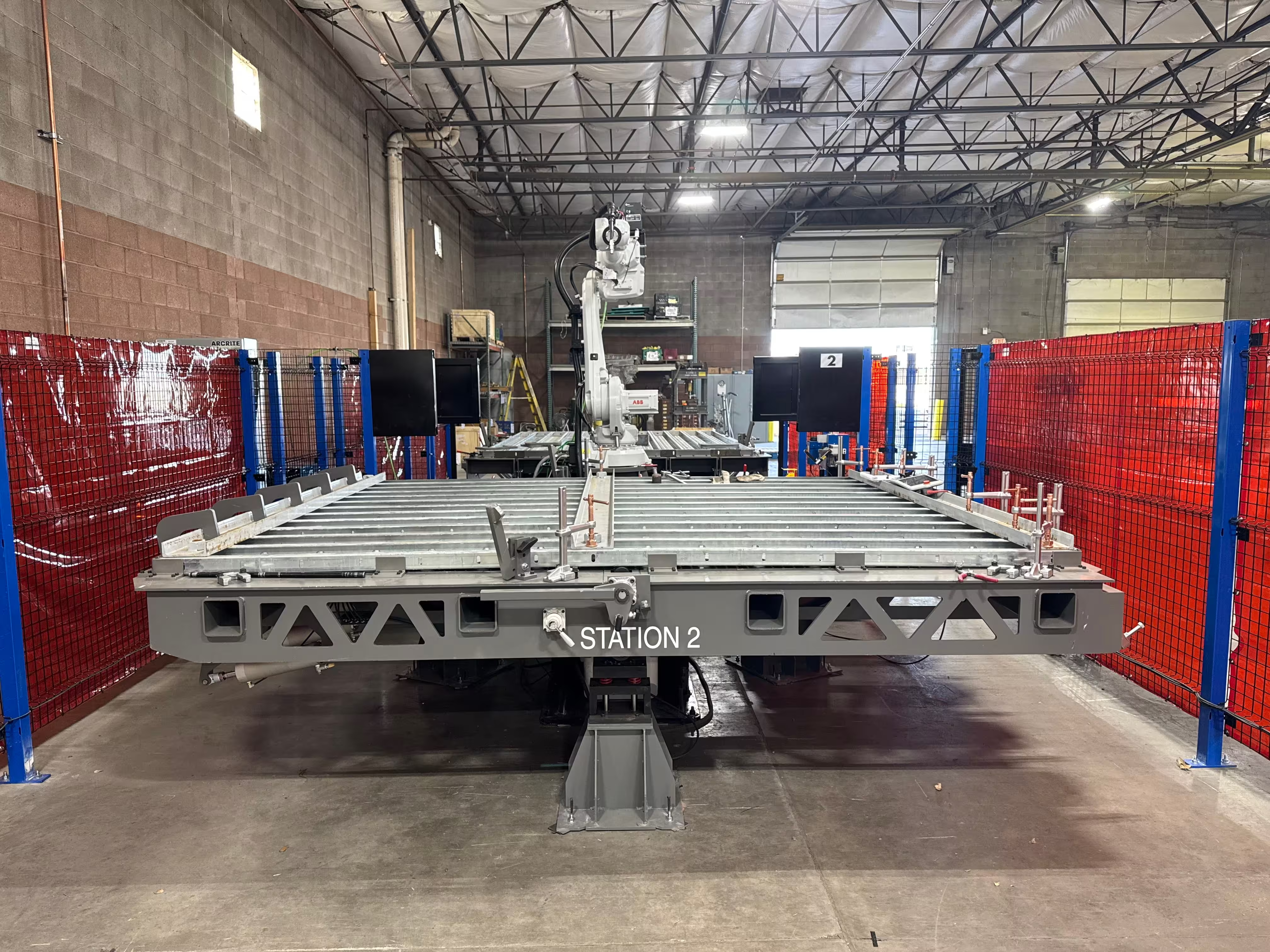
The design featured a dual-station setup: while the ABB robot welds parts at one station, the operator loads and unloads parts in the other. This configuration reduces robot idle time, keeps welding production moving between cycles, and maximizes operator’s productivity.
Custom Capabilities Arcrite Integrated For Den Mar Corp
Each robotic welding system includes:
- Robot: ABB IRB 2600ID industrial robot with an 8 kg payload and 2.0-meter reach.
- Welding equipment: Lincoln Power Wave R450 power source and water-cooled welding torch.
- Flexible welding tables: Four BuildPro Max welding tables, with two tables at each station.
- Torch maintenance: Abicor Binzel automatic torch cleaning system.
- Operator controls: Two dedicated consoles providing START, STOP, RESET, and EMERGENCY STOP functions.
- Safety equipment: Safety light curtains integrated to prevent automatic operation when an operator is detected in the protected area.
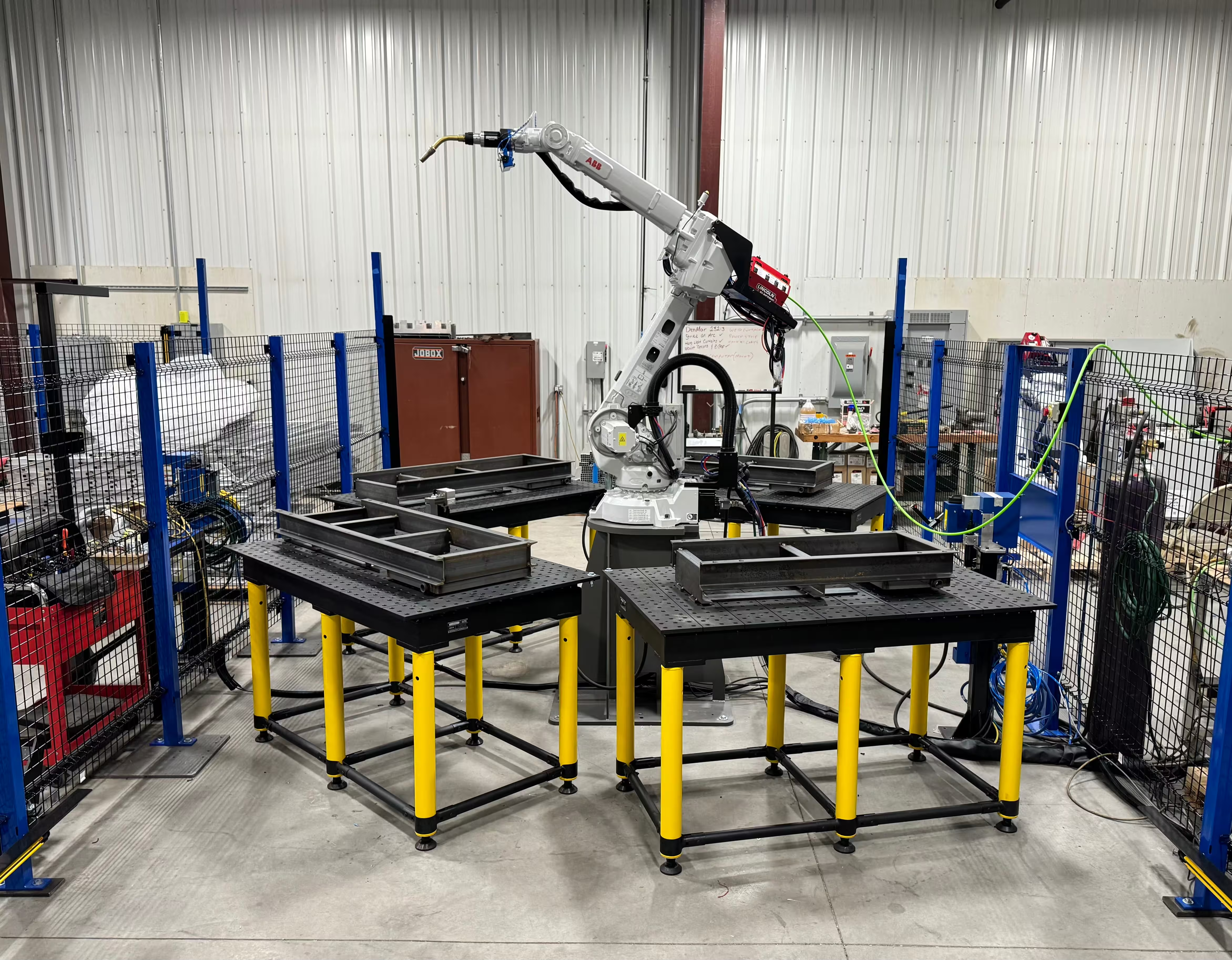
The complete system was designed to support flexible production while providing operators with straightforward controls for daily use.
Four Welding Tables Accommodate Different Part Variations
One of the primary requirements for Den Mar was organizing automation to weld different part variations without investing into dedicated robotic cells for each product.
Arcrite addressed this by integrating four BuildPro Max welding tables into each cell, providing a flexible platform for different workpiece configurations.
The tables were selected to accommodate Den Mar's customer-supplied fixturing plates, allowing the existing tooling to fit directly onto the welding surfaces. Each system can handle four different part variations while ensuring repeatable positioning. Den Mar can now adapt to part requirements without replacing robotic equipment.
One Week of On-Site Training to Prepare Operators
Delivering the welding equipment was only part of the project. Den Mar's team also needed to understand how to operate, adjust, and program the systems.
Following installation, Arcrite provided one week of on-site training at the customer's facility.
The training covered:
- Robot fundamentals: Understanding basic robot functions and operation.
- Programming basics: Introducing operators to robotic programming and adjustments.
- Complete system operation: Training employees to operate the welding cells correctly and safely.
This hands-on training prepared Den Mar's team to manage daily production and accommodate the different part variations the equipment supports.
The Results: Higher Output, Consistent Welds, and Shorter Lead Times
Den Mar not only increased output and improved weld consistency, but also reduced reliance on manual labor. This means higher throughput while improving overall production reliability.
Key outcomes:
- Higher productivity: Den Mar can manufacture more steel parts during a single shift.
- Shorter lead times: Increased welding capacity helps the company complete production orders faster.
- Consistent weld quality: Automated welding provides repeatable results across different steel part variations.
- Greater flexibility: Four welding tables per cell accommodate multiple workpieces using customer-supplied fixturing.
- Reduced labor costs: Automated production allows Den Mar to manufacture more parts with less manpower.
By combining flexible welding tables, dual-station robotic automation, and hands-on operator training, Arcrite delivered three production-ready systems tailored to Den Mar's manufacturing requirements.
The DenMar project demonstrates how robotic welding can support high-mix steel fabrication, helping manufacturers increase production without sacrificing the flexibility needed to accommodate different workpieces.