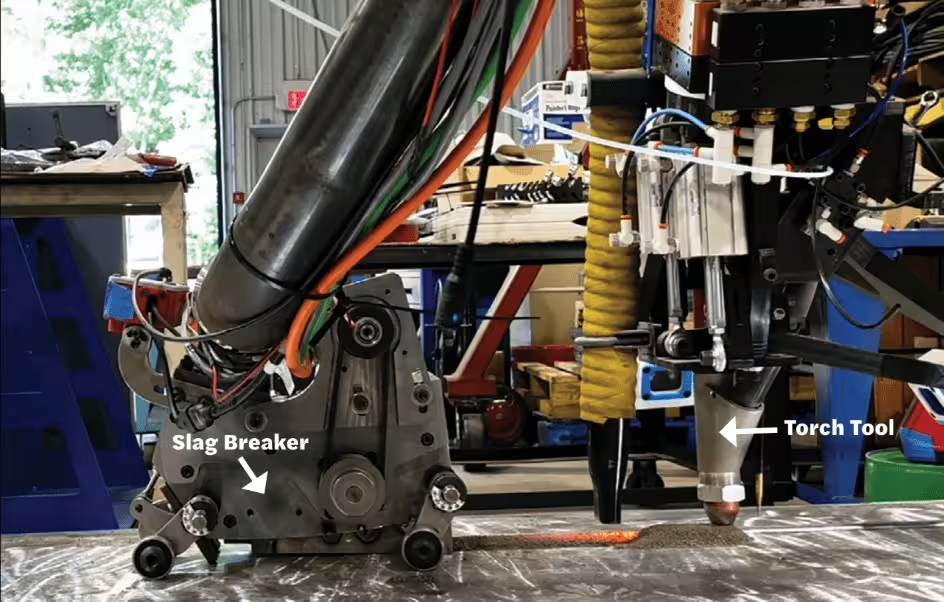
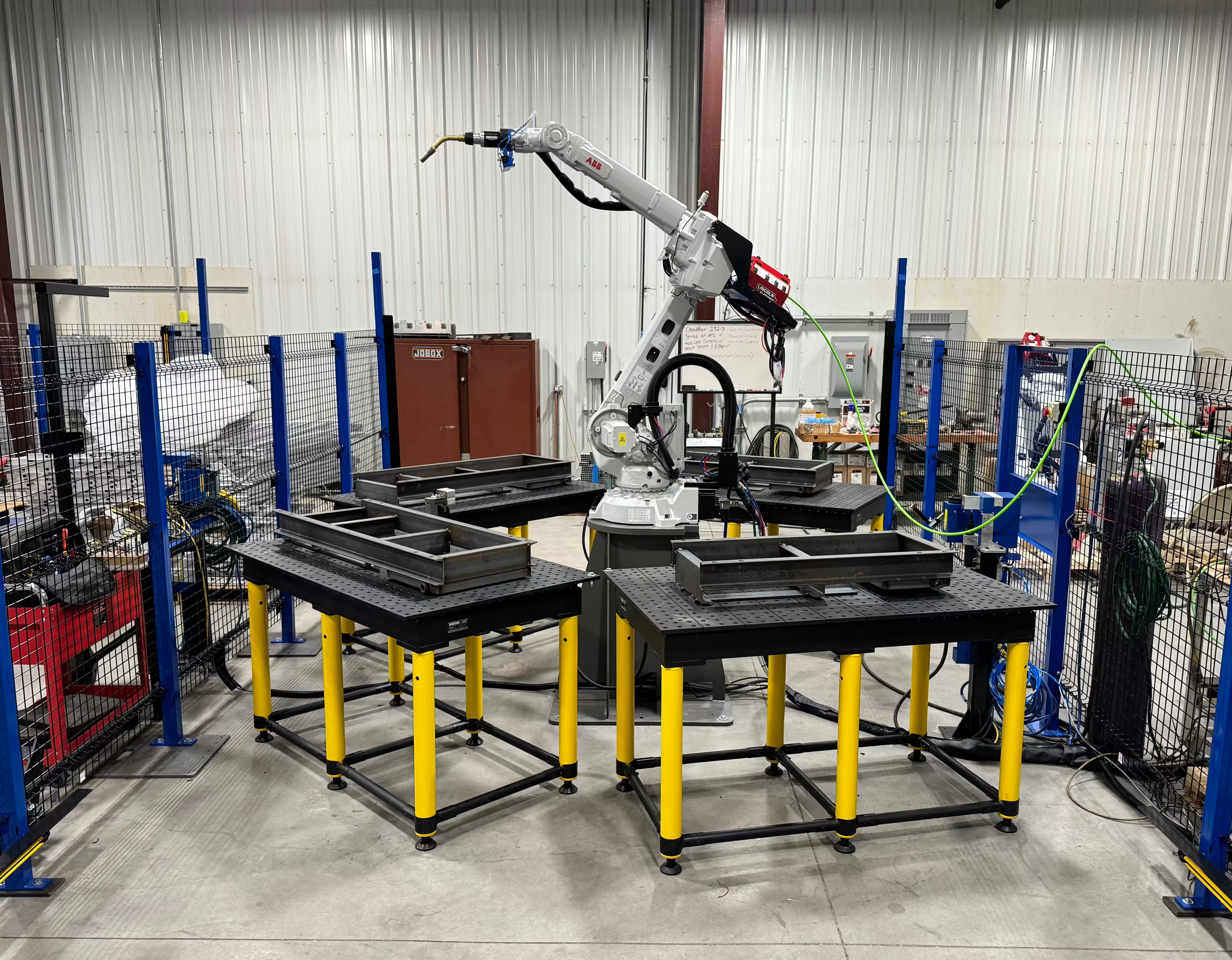
Arcrite Automation helped KieTek increase production while reducing labor from 2–3 employees to just one operator.
KieTek manufactures large galvanized steel assemblies for material handling applications. With each assembly requiring 106 welds, manual welding was labor-intensive, time-consuming, and increasingly difficult to sustain amid a shortage of skilled welders.
KieTek partnered with Arcrite Automation to develop a turnkey robotic welding system capable of handling two different assembly styles, reducing cycle times, and delivering consistent welds.
Project Highlights:
- 1 operator instead of 2–3 employees
- 106 welds automated per assembly
- 2 welding stations served by a single robot
- 110 × 139-inch custom positioning tables
- Higher production output with shorter welding cycles
The Challenge: Automating Large Steel Assemblies Without Distortion
KieTek needed to automate welding on two styles of large galvanized steel material handling racks. However, their size, material combinations, and welding requirements presented several challenges:
- Weld distortion: Welding heat caused the large, flat assemblies to bow, requiring specialized fixturing to maintain part geometry.
- Material differences: Each assembly required consistent welds between 11-gauge galvanized steel and ½-inch flat stock or painted channel stock.
- Part handling: Large, heavy assemblies required custom positioning equipment and additional support.
- Production flexibility: The system needed to accommodate two different assembly styles while remaining easy for operators to use.
KieTek also wanted a single integrator to supply the complete system, including robotic equipment, custom tooling, fixturing, and programming, rather than coordinating multiple vendors. And that’s where Arcrite comes into the picture.
Validating the Robotic Welding Application
Before designing the final system, Arcrite evaluated KieTek's existing manufacturing process to demonstrate how automation would improve production.
The team visited the facility and recorded the manual manufacturing process. This helped identify opportunities to reduce welding time and improve efficiency.
Arcrite then developed a 3D SolidWorks concept incorporating KieTek's actual parts, allowing the customer to visualize the proposed robotic cell and understand how it would operate.
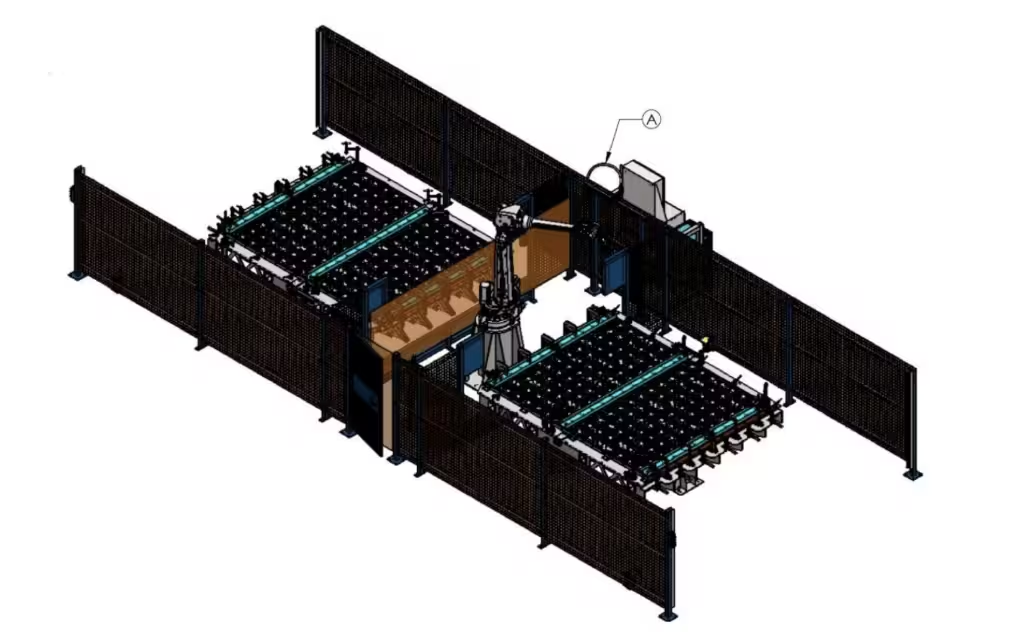
Combined with cycle-time verification, this evaluation gave KieTek a clearer picture of the system's capabilities and expected production improvements before investing.
The Solution: A Custom Two-Station Robotic Welding Cell
Arcrite engineered a turnkey dual side loader system featuring an ABB IRB 4600 robot positioned between two welding stations.
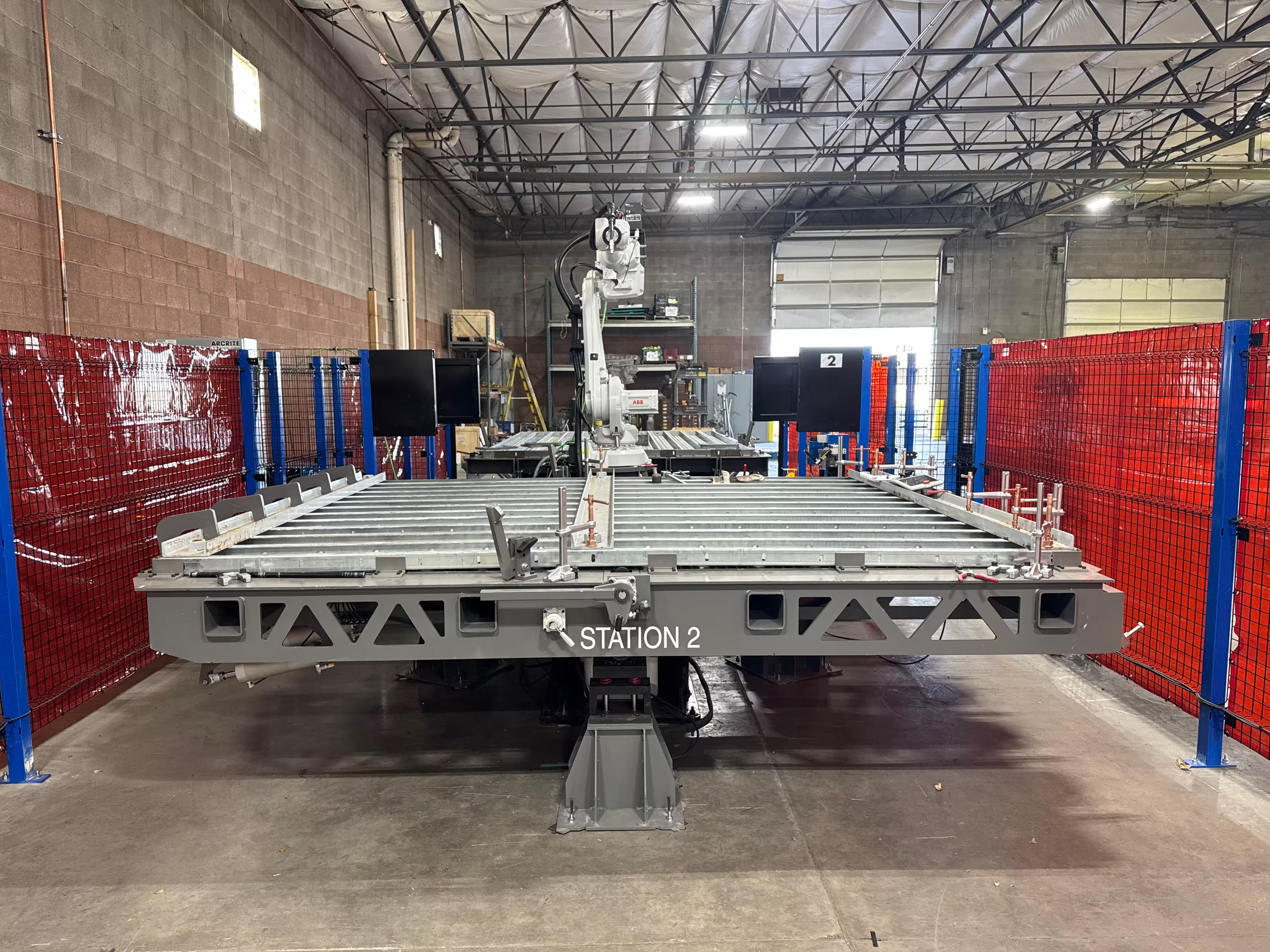
While the robot welds at one station, the operator can load or unload parts at the other. Essentially, one operator can run the entire system, cut down the idle time, and improve the productive welding time.
Custom Capabilities Arcrite Integrated For KieTek
| Capability | Description |
|---|---|
| Custom Workpiece Positioning | Arcrite engineered 110 × 139-inch positioning tables with additional supports to securely hold and rotate KieTek's oversized steel assemblies during welding. |
| Weld Distortion Control | Pneumatic cylinders and clamps pre-bend each assembly to compensate for anticipated weld distortion, helping the finished parts return to flatness after welding. |
| Dual-Station Production | One robot serves two welding stations, letting an operator load or unload parts at one station while welding continues at the other and reducing robot idle time. |
The system includes:
- Robot and positioners: One ABB IRB 4600 robot and two ABB MTD-2000 rotary positioners, each rated for 2,000 kg.
- Custom positioning tables: Arcrite engineered and fabricated two 110 × 139-inch tables to support the large assemblies.
- Welding equipment: Miller Auto-Continuum 350 power supply and wire feeder, with automatic torch cleaning.
- Flexible tooling: Interchangeable fixtures designed for quick changeovers between KieTek's two assembly styles.
- Operator controls and safety: Dedicated consoles, safety light curtains, and area scanners integrated into the cell.
Custom Fixturing Compensates for Weld Distortion
Controlling weld distortion was one of the project's most important engineering challenges.
As welds cooled, thermal contraction could cause the large steel assemblies to bow. Standard fixturing alone would not adequately compensate for this deformation. Across assemblies of this size, even modest distortion can create geometry and quality issues.
To solve this, Arcrite engineered pneumatic cylinders and large clamps that pre-bend the assemblies in the opposite direction of the anticipated weld distortion.
The tooling pulls each assembly into a controlled position before welding, allowing the expected thermal contraction to help bring the finished part back toward flatness.
Combined with additional support structures for the oversized positioning tables, this custom tooling enabled Arcrite to address KieTek's part geometry and distortion challenges within an automated welding process.
The Results: More Parts Per Shift With Less Labor
The completed robotic welding system met KieTek's production objectives and has operated for multiple years since installation.
Key outcomes:
- Reduced load on fabricators: One operator now manages production previously requiring 2–3 employees.
- Higher productivity: Shorter welding cycles allow KieTek to manufacture more assemblies per shift.
- Consistent weld quality: Automated welding provides repeatable results across 106 welds per assembly.
- Greater flexibility: Quick-change tooling supports both assembly styles within the same robotic cell.
- Simplified operation: Dedicated operator controls and integrated safety equipment support daily production.
By combining application evaluation, custom engineering, and turnkey integration, Arcrite delivered a robotic welding system tailored to KieTek's manufacturing requirements.
The project demonstrates how custom positioning, distortion-control fixturing, and application-specific engineering can make robotic welding practical for large assemblies that conventional automation systems struggle to accommodate.