General Dynamics Electric Boat faced a difficult manufacturing challenge. They needed to eliminate the need for welders to enter confined, preheated tanks to perform submerged arc welding without compromising production quality.
The proposed solution also had to meet the demanding welding quality requirements and established procedures of submarine manufacturing.
Working with Arcrite Automation, Electric Boat developed a custom robotic welding system that can perform automated sub-arc welding and supporting operations remotely.
In September 2025, the system completed its first production tank closure head interior weld and achieved 100% satisfactory results in volumetric inspection.
The Challenge: Eliminating Confined-Space Welding Without Compromising Quality
At Electric Boat's Quonset Point facility in Rhode Island, shipbuilders traditionally had to enter the interior of a tank through an opening about 1.5-ft inches in diameter.
Inside, they faced temperatures reaching up to 300°F, confined working conditions, and a rotating environment. To manage these hazards, welders used air-fed respirators and took frequent breaks.
Electric Boat wanted to eliminate the need for personnel to enter these tanks. But they also wanted to maintain the quality of their established welding operations. Compromising on either end was unacceptable.
Why Conventional Robotic Welding Wasn't Enough
However, automating the process presented an unusual challenge. The system needed to perform submerged arc welding and supporting operations such as slag removal, cleaning, inspection, and temperature measurement.
All these operations had to take place through the tank's restricted opening. If even one task still required someone to enter the tank, the automated system would fail to meet its primary safety objective. Meanwhile, the limited space constrained the size and movement of the robotic equipment needed to perform each operation.
Getting the sub-arc welding torch into the tank was a challenge, but it was only the tip of the iceberg. During submerged arc welding, the torch needs a continuous supply of granular flux, while excess flux and slag must be removed. Previously, a welder inside the tank could handle these tasks manually. With no one inside, the system had to deliver and remove these materials remotely, even while welding was underway.
Removing welders from the tank also required preserving their control over the process. Operators still needed to see the weld clearly, guide the torch into position, and make adjustments as needed. The system therefore had to provide the visibility and control necessary to perform these tasks from outside the tank.
Engineering a Custom Robotic Submerged Arc Welding System
Arcrite and Electric Boat collaborated to develop a custom robotic welding cell designed around the tank's physical constraints and the complete submerged arc welding process.
Custom Capabilities Arcrite Integrated for Remote Sub-Arc Tank Welding
| Capability | Description |
|---|---|
| Overhead Gantry Robotics | An inverted industrial robot travels along an overhead linear system to position welding and processing tools through the tank's restricted opening. |
| Submerged Arc Welding Tooling | The team modified the welding head's geometry to accommodate restricted access and robotic movements while retaining the established torch model. |
| Flux Delivery and Slag Recovery | A custom air-fed system delivers welding flux, while a separate slag breaker uses mechanical hammers and vacuum extraction to remove slag and excess flux during welding. |
| Multi-Tool Robotic Integration | Automatic tool changing enables a single robot to switch between welding, wire brushing, grinding, visual examination, and temperature measurement. |
| Remote Welding Controls With HMI | Live camera feeds, programmed entry and exit routines, and direct operator controls allow operators to manage critical welding operations from outside the tank. |
The system uses an overhead industrial robot that can position a welding torch and other processing tools inside the tank through its restricted opening. As the tank rotates, the robot maintains the torch at the weld joint, allowing the system to perform circumferential welds without personnel entering the vessel.
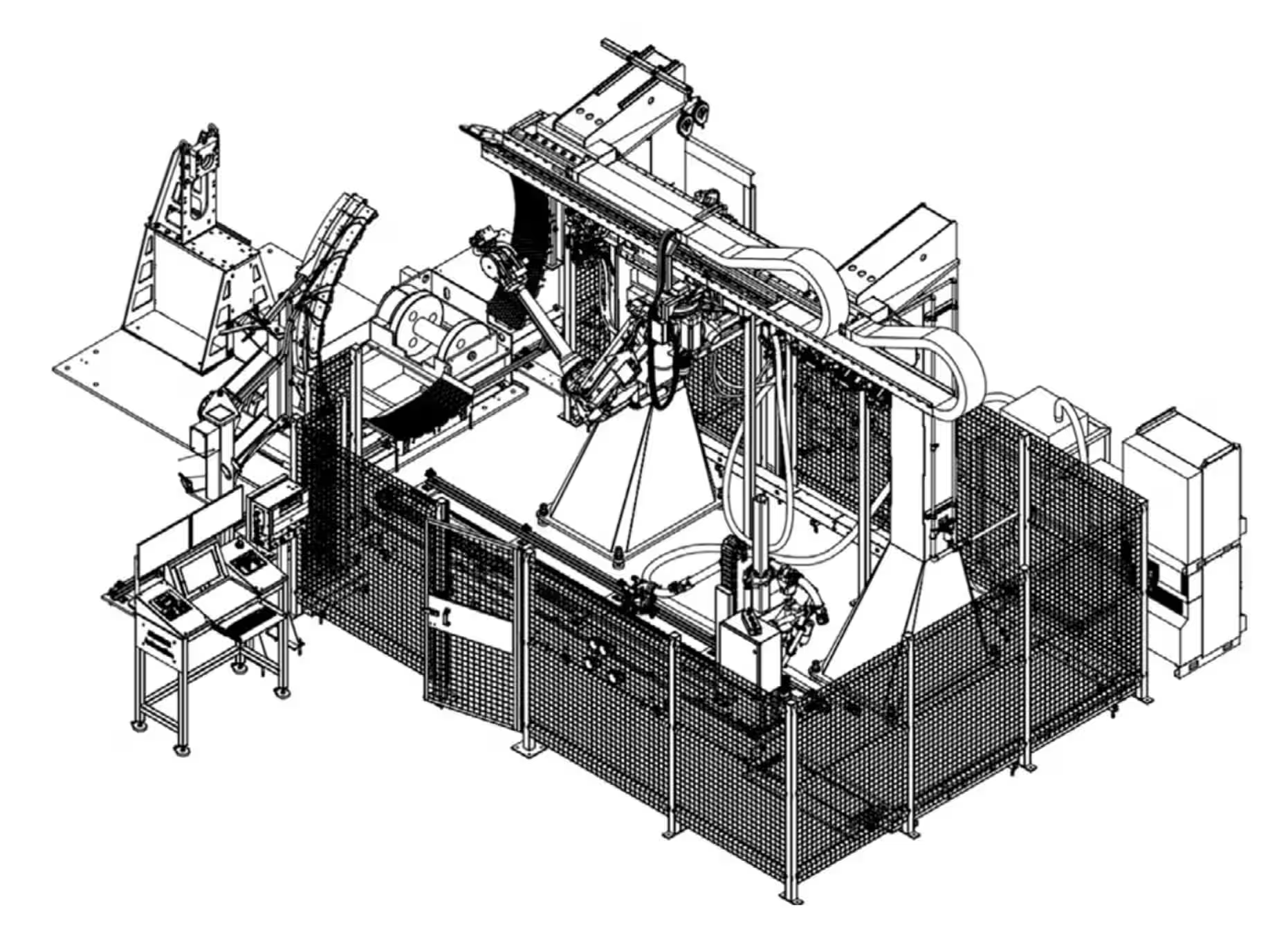
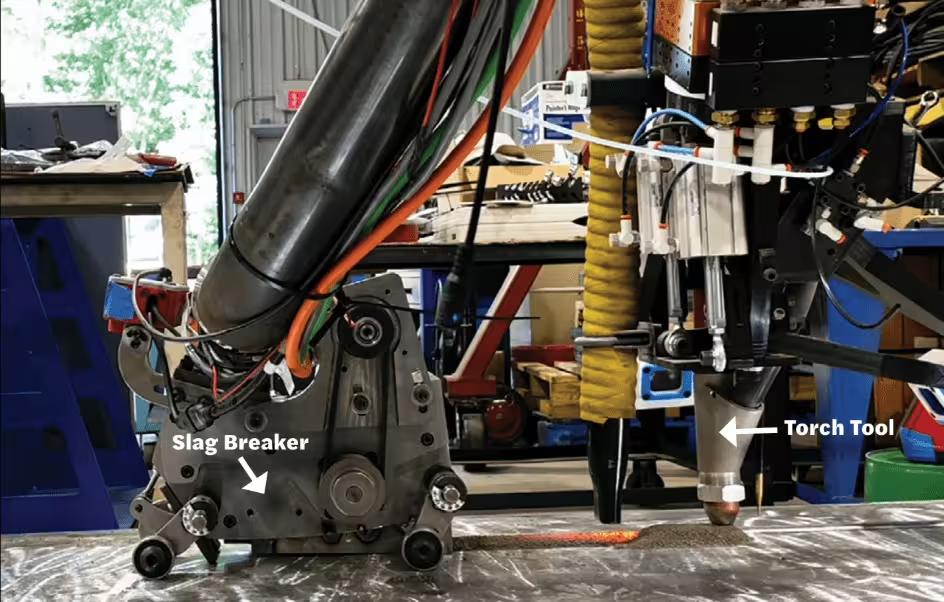
The robotic application also required a different approach to automated flux delivery. The robot's movements through the restricted opening made conventional gravity-fed flux hoppers unsuitable, so the team developed an air-fed system to deliver flux remotely. A separate, custom-built slag breaker follows behind the welding torch, using mechanical hammers and a vacuum system to remove excess flux and slag during welding.
The robot also uses an automatic tool changer to switch between specialized tools for wire brushing, grinding, visual inspection, and temperature measurement. This allows the system to complete the operations required between weld passes without manual intervention inside the tank.
Operators control and monitor the process from a remote console equipped with live camera feeds and an intuitive human-machine interface (HMI). Automated entry and exit routines help position the tools safely through the restricted opening, while operators retain direct control over torch positioning and other critical functions.
The system also retained the same welding torch model used in the conventional process, but with modified geometry to accommodate the robotic application.
Tested, Validated, and Proven in Production
Before implementation, the robotic welding system underwent extensive testing to verify that each operation met the required manufacturing standards.
The team individually evaluated the welding torch, slag breaker, and temperature measurement tools, while rigorously testing the new air-fed flux delivery system under demanding environmental conditions.
Crucially, all collected flux samples remained below the maximum allowable moisture content. This was a critical requirement for using the flux tank in shipyard operations.
The team then tested the complete system using a mockup matching the geometry of the production tanks. Both the development team and future operators welded the mockup, allowing the people who would use the system in production to evaluate its operation and request final adjustments before implementation.
In September 2025, Electric Boat successfully completed its first tank closure head interior weld using the robotic cell at its Quonset Point facility. The weld achieved 100% satisfactory results in volumetric inspection, demonstrating that the system could maintain the required weld quality while eliminating the need for personnel to enter the tank.
For Arcrite, the project demonstrates the value of engineering robotic automation around the customer's manufacturing requirements. By combining application-specific engineering, custom tooling, and extensive validation, the team helped turn a challenging confined-space welding operation into a remotely operated production process.